

MEXICO CITY (CN) - For the first time, Mexican citizens voted on Sunday for almost 3,000 judicial officials, from the Supreme Court to district magistrates. The election was part of a reform passed in September 2024, when the ruling Morena party claimed to want a drastic change in what it deemed a corruption-plagued power.
The election has drawn tension and criticism from many in the opposition, however; they consider it a means for the current administration to gain more power, especially over Supreme Court judges, who have blocked several of the party's reforms in the past.
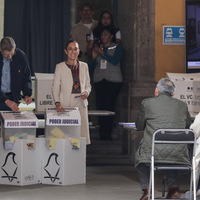
Less than 14% of the nation's 100 million voters voted in the election - a sparse figure compared to presidential elections, where lines tend to form down the block. Various polling places in downtown Mexico City were nearly empty in the morning and afternoon, with no wait time to enter the buildings to cast a vote. A Pew Research poll from May 22 showed two-thirds of Mexicans favored voting for the judicial branch.
The complete election results are expected to take two weeks. Elected officials will be sworn in on Sept. 1.
"I'm voting because I want the corruption to end," a 48-year-old waiter who asked to keep his name anonymous said on Sunday. "There are innocent people in prison, and judges have a lot of power, they make a lot of money."
A supporter of the "4T" - the "Fourth Transformation," Morena's political program to decrease poverty, weed out corruption, reform the legal system and implement sovereign energy programs - the waiter said he believed the election to be a step forward in intensifying the reforms. However, he had not decided whom he would vote for an hour before heading to the polls.
Experts said the sheer number of candidates causing complicated ballots was a cause for concern.
In Mexico City, the public voted on 51 different judicial positions: 39 federal and 12 local. Candidates were not allowed to campaign by party affiliation, accept public funding or campaign on radio or television.
On Thursday, a political group was caught distributing voting "cheat sheets" that suggested which candidates to vote for.
The Superior Chamber of the Electoral Tribunal of the Judiciary deemed the distribution of these pamphlets illegal on Sunday. Mexico's National Electoral Institute said later that day it was acceptable to bring in notes to the polls as long as the notes didn't influence the vote or contain propaganda.
Another voter, Maria de la Luz Morales, said that the ballots were slightly confusing, but only because it was the first time the country had voted for the judicial system.
She voted because she believes that the current justice system favors only the rich.
"We want a justice system that protects everyone. We hope that this will continue for years. We, as the adults, want to set an example for young people so that they can have what is best and that justice will be done for the well-being of all - not just the rich," said de la Luz Morales outside of a polling place near Mexico City's Palacio de Bellas Artes.
Juan Manuel Mora, 30, who runs a newsstand in the downtown neighborhood of Tabacalera, voted for both President Claudia Sheinbaum and her predecessor, Andres Manuel Lopez Obrador, but did not vote on Sunday.
Despite Morena party support, Mora doesn't trust this particular electoral process.
"I didn't get to know the candidates, and it wasn't worth it for me to vote in this election. I've voted to support the Morena party, but the judges have already been chosen. Our vote doesn't mean anything, this is the reality," Mora said.
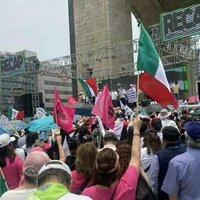
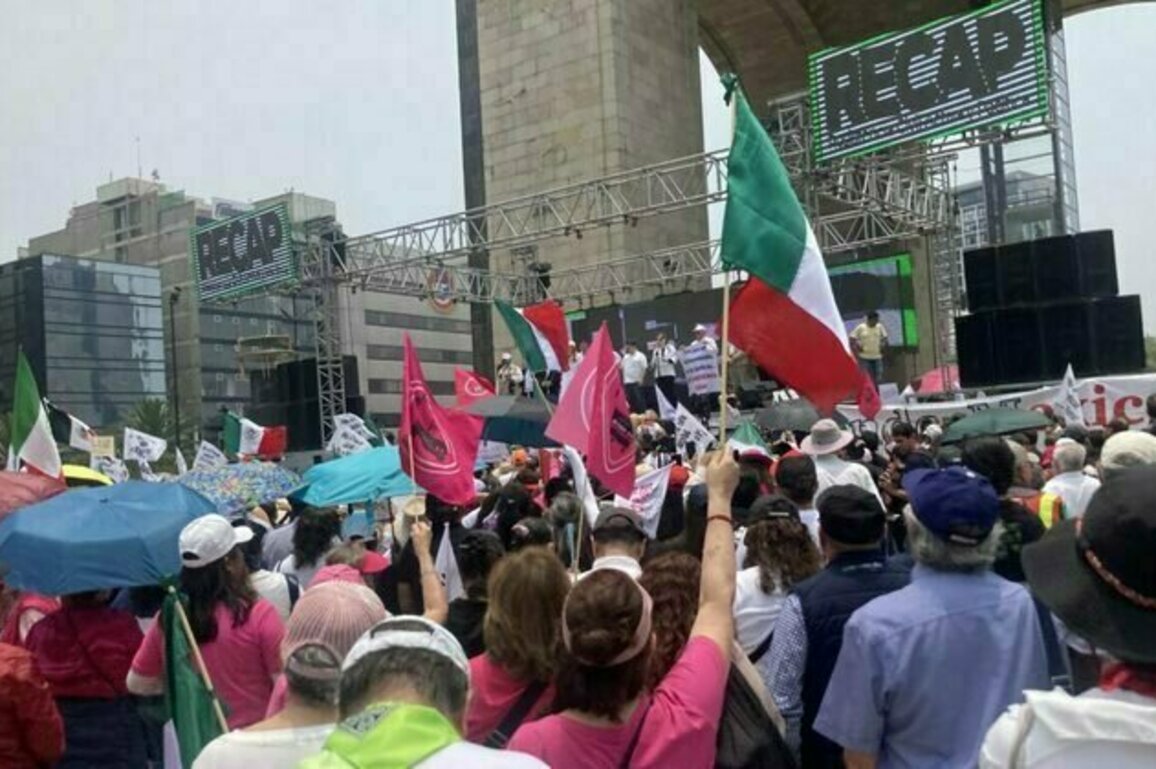
Just down the street, hundreds of anti-Morena party demonstrators protested the elections, a day they called Domingo Negro, or Black Sunday, in keeping with their complete rejection of the judicial election.
Organized by Resistencia Civil Activa y Pacifica, or RECAP, the group marched from Mexico City's iconic Angel of Independence to the monument honoring the Mexican Revolution with signs denouncing the election as fraud.
"Today, we call for a mobilization that, with renewed force, refuses to renounce those democratic advances that we have already achieved. We will never accept a populist exercise that does not deserve to be called an election, and opens the door to the long night of authoritarianism," said Maria del Carmen Alanis, ex-president of the Electoral Tribunal of the Judicial Branch of the Federation in a speech.
Alejandro Monsivais-Carrillo, a political science professor at El Colegio de la Frontera Norte, is particularly worried about the current administration's good-versus-evil populist attitude, which he said began during Lopez Obrador's presidency.
"It is a widespread phenomenon. But in Mexico, it's closely intertwined with the ascent of AMLO and Morena. They deploy this characteristic of good versus evil, of the people versus the elites. AMLO was able to build a political regime that resembles his rhetoric," Monsivais-Carrillo said.
During her morning press conference, Sheinbaum deemed the election "unprecedented."
"It's a success," she said. "People took part in freedom, and those who wanted to protest protested freely, too." Thirteen million people took part in the election, she said, proclaiming it a victory despite the opposition's call not to head to the polls.
A year ago, on June 2, 2024, she became the first female president of Mexico in history following the six-year mandate of Lopez Obrador, a presidency that broke with the right-wing leaderships of the previous decade. On Sunday, during election day, Lopez Obrador reappeared for the first time since his retreat to Chiapas after he passed on the torch to Sheinbaum last October.
"Never in history had the people chosen directly for judges and ministers," he said. "That's why I wanted to take part in this historic election - and I'm happy to live in a free, democratic country."
Both his silence back then and his reappearance yesterday were read as signs of support and respect towards Sheinbaum. Recently, Atlas Intel released a survey showing Sheinbaum's popularity above 70%.
Source: Courthouse News Service