

ZACATECAS, Mexico (CN) - Tropical Storm Raymond hit Chiapas state the week I arrived, leaving roads flooded and eroded in the small town of Chicoasen.
As the skies calmed, it was clear that no amount of rain would stop the families eager and ready to watch a spectacle unfold in their small town. When I visited on Oct. 8, they sat along the main road and on the concrete roofs of small stores, propping umbrellas to shield themselves from the stifling heat.
We were all here to see "La Carrera Panamericana," Spanish for the Pan-American Race. Although the exact route differs each year, the weeklong affair takes racers from jungly southern Mexico to the deserts and high plains in the center of the country.
This year's route began in Chiapas on Oct. 9 and ended in Zacatecas on Oct. 16 - taking racers around 2,000 miles through nine Mexican states over eight days of driving. More than a race, the Carrera Panamericana is a symbol of national pride and a journey through the many landscapes and cultures of this country.
The Carrera Panamericana consists of two distinct stages. During "speed stages," cars compete against the clock on completely closed roads.
During "transit stages," participants join ordinary traffic until they reach the next speed stage. These transit stages aren't timed.
There are up to 14 speed stages per day, made more difficult by long transit stages between them. At the end of the Carrera, the car with the lowest accumulated time wins. There is no prize.
My first experiences with the race had really begun the night before. I'd visited a race safety inspection in nearby Tuxtla Gutierrez, the biggest city in rural Chiapas.
I'd met a couple racing teams, including a three-man Mexican team made up of Ernesto Martinez, Jesus Mejia Arroyo and Leon Adalberto Franco. They usually race Ford Mustangs at Club Mustang Metropolitano in Mexico City where they live.
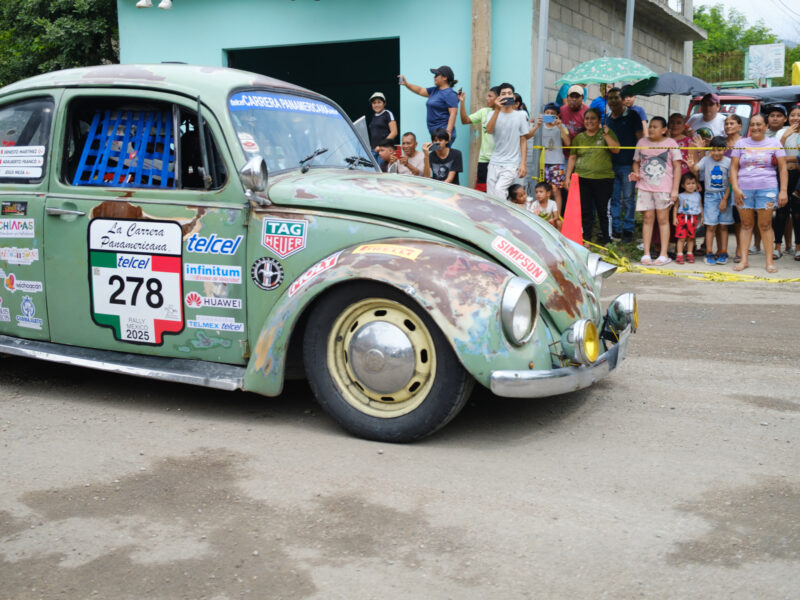
This year, for their first Carrera Panamericana, they were racing a patina-green Volkswagen Beetle. Green Beetles were once often used by Mexican taxi drivers and are a symbol of the country.
Martinez, the team's driver, told me he was feeling confident about the race.
"All the sections have their charm," he said. "Obviously, the speed sections are sections that you have to be careful in. You have to drive them well." Still, "as long as we don't lose respect for the road and the car, we can make it safely through any stretch."
I also met Doug Mockett, an American driver.
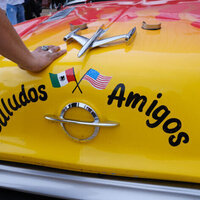
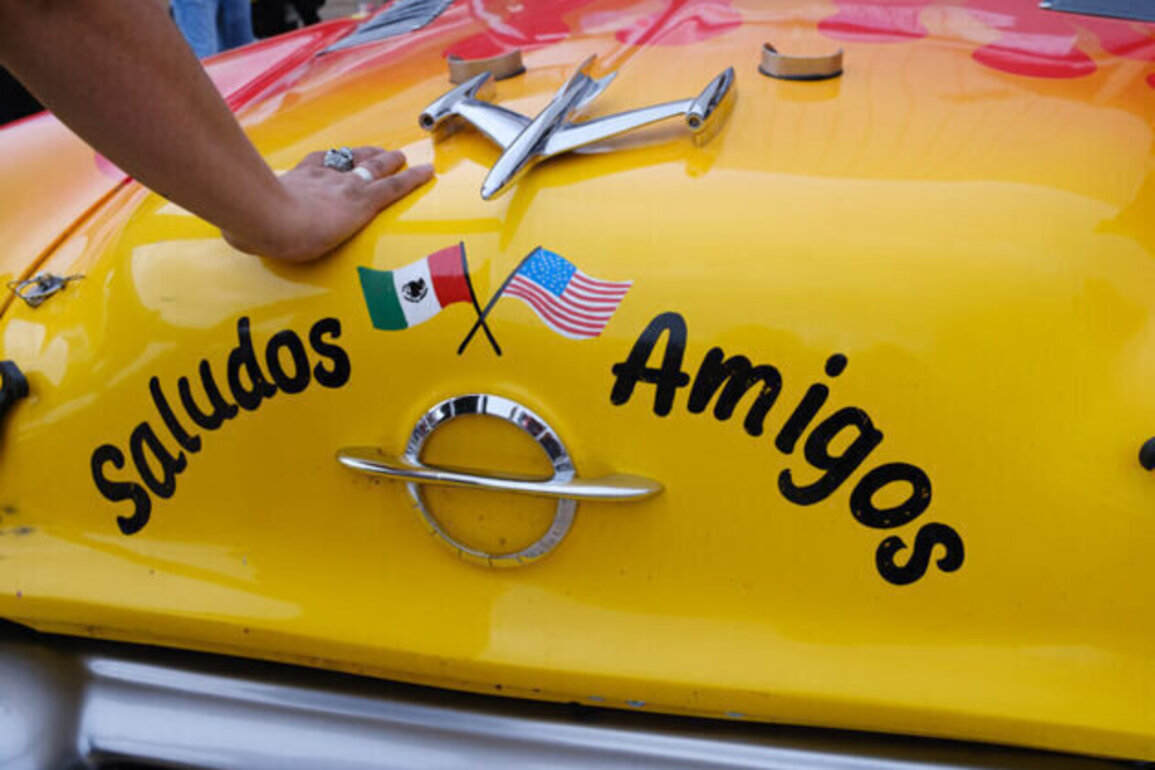
His car of choice: a red 1954 Oldsmobile adorned with yellow flames and American and Mexican flags. A message on the car read "Saludos Amigos" or "Greetings, friends."
Mockett has raced in the Carrera Panamericana for more than 20 years. He won the whole thing back in 2002. Even so, he was humble and nonchalant about the race when I talked to him.
"Sure, I'm excited," he said. "It should be a lot of fun." He seemed more interested in hearing how my first Carrera Panamericana was going. "How are things with you? Are you enjoying yourself?"
Now it was the day before the race, and we were all gathered in Chicoasen for something of a kick-off ceremony.
National Guard vehicles moved through to clear the road. Spectators ate snacks and looked for a good place to watch. Some wondered aloud when the cars would rumble through town for the first time in a decade.
I ducked into the shadow of a small convenience store.
A strange noise came from up the road. A car-like apparition came lumbering slowly down the hill, pulling into the town's gas station.
On closer inspection, the apparition was a silver and orange 1965 Ford Falcon. The Germans in the car - driver Marc Tenbcken and navigator Max Loder - had arrived too late to make the qualifying round. It was their first Carrera Panamericana, and they weren't exactly sure where they were supposed to be.

"Are the cars coming through here? Is there where the race is?" Tenbcken asked as kids ran towards him asking for photos and autographs.
I told him the other racers should be coming soon, though honestly, I didn't really have a clue.
Truth be told, I had no idea how this thing really worked. I didn't understand how for decades, organizers had pulled off a multiday race through some of the roughest and most rural roads in North America.
I also wondered how I myself would pull this thing off.
Coordinators had been emphatic: To stay in front of road closures, I would need to travel two hours ahead of the race each day. In a sense, I would be racing the race myself.
I would worry about that later. For now, it was time to take in the festivities.
I met Patricia Acuna, Jose Luis Gonzalez and their two small daughters, all waiting on a bench by the side of the road. It was their first time seeing the Carrera.
"We can't wait to finally take advantage of the race this year as it comes through our town," Acuna said. "It's a good town, difficult for work but very beautiful because of the river."
The first Carrera Panamericana was held in 1950 to commemorate the completion of the Mexican leg of the Pan-American Highway.
It was canceled after the 1954 race, in which seven people died. Between 1950 and 1954, 27 drivers and spectators died during the race. It was later revived in 1988 and has happened every year since.
The race features classes of touring, sport and historical cars. There's also an exhibition class consisting of show cars that don't participate in the actual competition.
There were 51 cars this year, including drivers from Sweden, Canada, Germany, the United Kingdom and the United States. Among them were Tenbcken and Loder, who'd lucked out and been able to sign up after all.
Kids yelled "adios" as the cars came rolling down the hill.
I saw Martinez in his patina-green Beetle. "Bocho, bocho, bocho!" the kids chanted, using the Mexican Spanish slang term for a Volkswagen Beetle. Behind him was Mockett in his flame-decorated Oldsmobile.
I returned to Tuxtla Gutierrez later that night for an official opening ceremony.
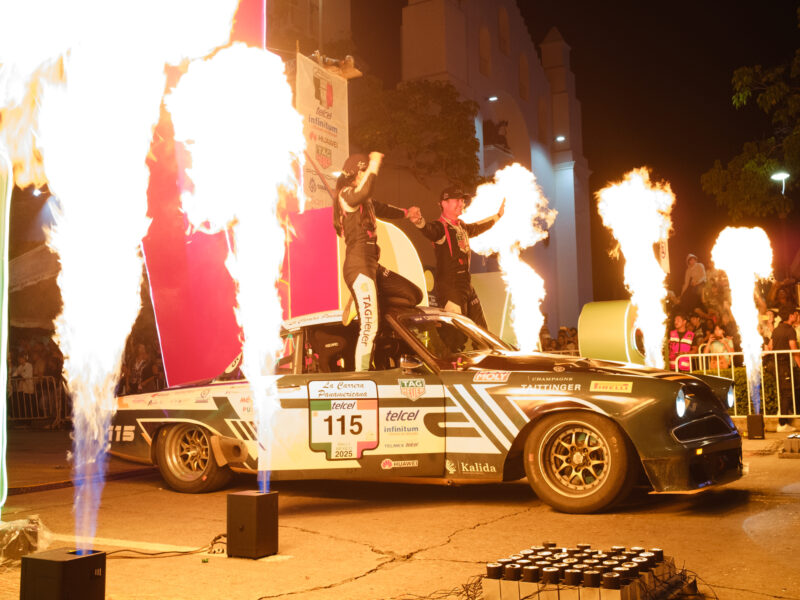
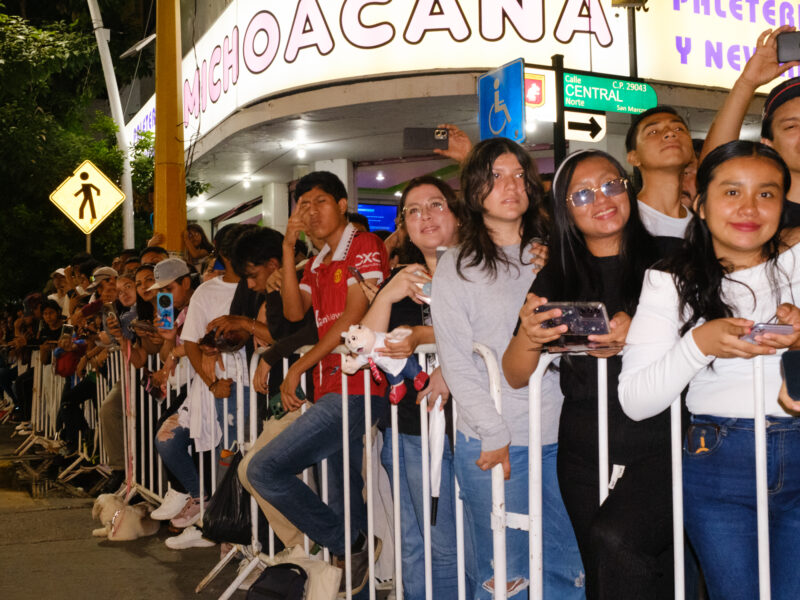
Hundreds of people lined the main boulevard, pressing against barricades as they waved to the cars. An official opening ceremony featured a mix of AC/DC and regional banda music, all blasted from speakers. Revving their engines, drivers gave out autographs and took selfies with screaming spectators.
Fireworks shot into the sky. There was the hum of engines and the smell of exhaust as children chanted for their favorite drivers.
I spotted a German driver and American navigator whose misadventures had preceded them.
They had just arrived with their blue Mercedes from Panama, where the car was accidentally shipped. To get to the race on time, they had only a few days to traverse multiple countries, including Panama, Costa Rica, Nicaragua, Honduras and Guatemala. Then they had to take a ferry to northern Chiapas and drive some more. All that before the actual 2,000-mile race had even begun.
"Ah, you made it!" I yelled to the driver, Jrg Sand. I was caught up in the excitement of this scene, but we didn't know each other, and Sand seemed a bit taken aback by my familiarity.
"Yes, we are finally here," Sand said plainly. He was tinkering with a rally sticker on his car. "It's already been a very long trip, to say the least."
The next day, Oct. 9, was the first day of the race: a 10-hour drive through the Isthmus of Tehuantepec into Oaxaca.
Tropical Storm Raymond had collapsed entire trees onto Federal Highway 190, making the one-lane road barely passable. As I began my drive from Tuxtla Gutierrez, light tinted by the clouds turned the landscape a ghostly blue.
Driving ahead of the race, I arrived around noon to a canyon in the Sierra Madre del Sur mountains - the site of what would soon be the next speed stage. It was mezcal country, and wild agave grew all over the canyon and up the surrounding mountainsides.
A police officer was standing watch at a turnoff spot. I pulled over and said hello. She introduced herself as Elizabeth Blanco, a Oaxacan state transit cop - one of the many officers brought in for the mammoth task of closing and clearing the highways.
We waited together for a couple hours under the blazing sun.
"I've been here for two hours, and no sign of anything," Blanco said. "You picked a good spot here."
She made small talk about her family to pass the time. "My nephew sometimes talks to rocks," she said. "He'll say, 'This is a beautiful rock,' and he'll talk to it, telling it different things."
Suddenly a rumble echoed through the canyon. Cars shot through in colorful, menacing bolts.
First up was El Malditillo or "The Little Damned One," a black 1954 Studebaker Champion with a grinning row of fangs painted on the sides.
Behind the wheel was six-time Panamericana champion Ricardo Cordero. Because of the way the Carrera is structured, with a focus on total accumulated times, Cordero was actually in second place at this point. He took a turn that seemed at first like it would launch El Malditillo into the air. Coming down the high mountain road, El Malditillo looked like a very fast eel slithering through the agave fields.
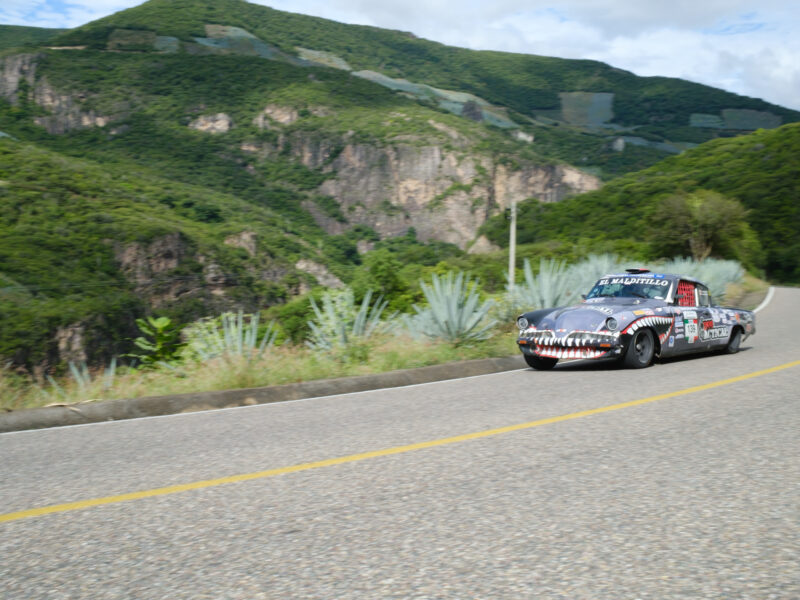
Rumbling filled the canyon as the other cars followed him. Each a different color, each with its own distinct engine sound.
A final sweeper car came through, followed by four National Guard vehicles.
It was the end of the speed stage. Time for me to figure out where I was going to catch up with the race cars next.
The decision was easy this time: Federal Highway 190 was the only road on this route. I followed the racers five hours to Oaxaca city.
There was a traffic jam on the way. Up ahead, an exhibition-class Porsche had tipped into a gully after taking a turn too hard.
As I made it farther, I passed a tiny red and green striped Porsche 356.
Driven by Willhelm and Walther Schmitt, it now looked like a crumpled-up beer can discarded beside the road. The Schmitts were the first 'did-not-finish' of the race. Thankfully, no one was hurt - a testament to the benefits of race-mandated roll cages.
Day two: Oaxaca city to Puebla city, a drive through some of the most historic and culturally distinct parts of Mexico.
Remnants of Mexico's colonial past are prominent here - but so are signs of Indigenous peoples and cultures. The landscape is rugged, dotted by active volcanoes and steep, rocky valleys.
As the sun rose, I arrived at a gas station in the small Oaxacan town of Asuncion Nochixtlan.
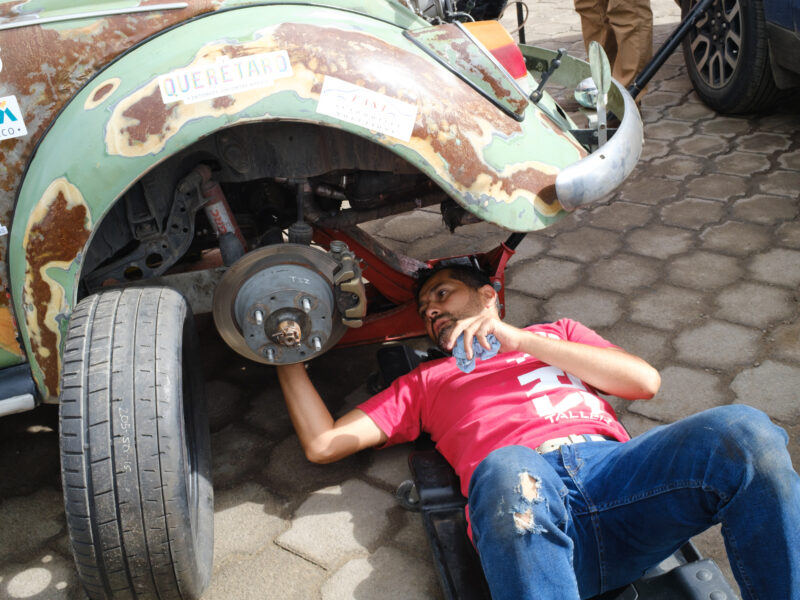
Mechanics had set up tents and were waiting for racers to come through. I met Marco Mercado, a mechanic for a 1973 Porsche 914. He has a garage in Mexico City called Pro Rally and has worked on cars for most of his life.
We chatted about the drive through Oaxaca yesterday, where the Porsche had crashed.
"It's a very complicated route, that one," Mercado said. "Not necessarily for its curves, but for its uphill climbs. Lots and lots of climbing uphill. And also, with the rain, it's been a bit of a mess."
The most difficult part of the race, Mercado said, was the wear on the body and mind. Drivers and their teams need to stay focused at all times despite very little sleep.
"That's what affects us the most," he said. "More the body than anything else."
Cars started arriving and lining up for gas. Amused attendants filled up their tanks as if it were any normal day. Card or cash?
Oscar Nava and Luis Lerdo de Tejada were sitting by their trailer. Part of Tequis Rally School, a famed rally school and garage in Queretaro, they had worked on previous winning cars. This year, they were part of the team for the patina-green bocho driven by Martinez.
Nava explained they were having some technical difficulties. An intercom system in the racers' helmets had gone down, so the driver and navigator had to use hand signs to communicate over the roar of the engine.
Having a navigator is integral for driving the Panamericana. They study hundreds of pages detailing every curve, climb and downgrade along the entire route. They communicate to the driver at each turn, letting them know exactly what to do.
Those are just some of the issues that a race mechanic faces. "We had a door that didn't close properly," Nava said. "Last night, we realized the engine was making a terrible sound, so we had to put it back together."
A friend had a steering wheel break on his Ford Falcon. "We knew someone who lives here, so we told him, 'Hey, this guy can help,'" Nava said. "The service crews are the ones who never sleep. They eat poorly, and they are behind the scenes. But a well-prepared car will never fail."
As for Lerdo de Tejada, he had been around racing his entire life. His uncle Juan Lerdo de Tejada raced in 1954 and designed the famous LT Special, a car made specifically for the race. Alas, because the Carrera didn't happen from 1955 to 1987, the original LT Special never got its shot at glory.
Lerdo de Tejada's father collected antique cars. He taught Lerdo de Tejada to drive at nine. At 12, Lerdo de Tejada got his first car, a Volkswagen Jetta.
They weren't called Jettas in Mexico, though. "We had the Atlantico brand," Lerdo de Tejada reminisced. "They were the ones from my era. At some point, when I was about 15, my dad bought two eight cylinder Mustangs. He got them fixed up, and we used to have a fun time with them."
Lerdo de Tejada explained that the Carrera Panamericana worked a bit differently in its early years.
Unlike today, drivers didn't have navigators. There was no distinction between speed and transit sections - and therefore, no distinction between closed-off sections of racetrack and normal roads with ordinary drivers.
It was still a wild and epic race, but a lot more on the fly. In some ways, the rules were simpler. Drivers could always try and pass each other. The first car to arrive at the finish line won.
Our conversation came to an end as racers began arriving at the station.
As usual, they were instantly swarmed by fans hoping for photos, autographs or just a handshake and a smile. After an hourlong allotted service time, the cars returned to the road. With a 30-second timer between them, they joined normal traffic for another transit stage.
After a day of driving through Puebla state with a stop at a reception for drivers in Tehuacan, I spent the night in Puebla city, the state's capital and largest city.
The next morning in Puebla, cars took formation outside the city's International Museum of the Baroque. In the distance, Popocatepetl volcano spewed ash into the sky.
Ricardo Cordero, the El Maldillito driver and six-time Panamericana champion, was in the lead. I found him organizing some belongings in his fanged Studebaker, his cowboy hat resting on the dashboard.
Two days before, Cordero's tire had blown out. He lost precious time, falling behind French driver Hilaire Damiron and Brazilian wife-navigator Laura in a green and white Studebaker.
"We're still in the fight," Cordero said. "We are going to get back what we lost, and I am excited to get to Mexico City to see my family."
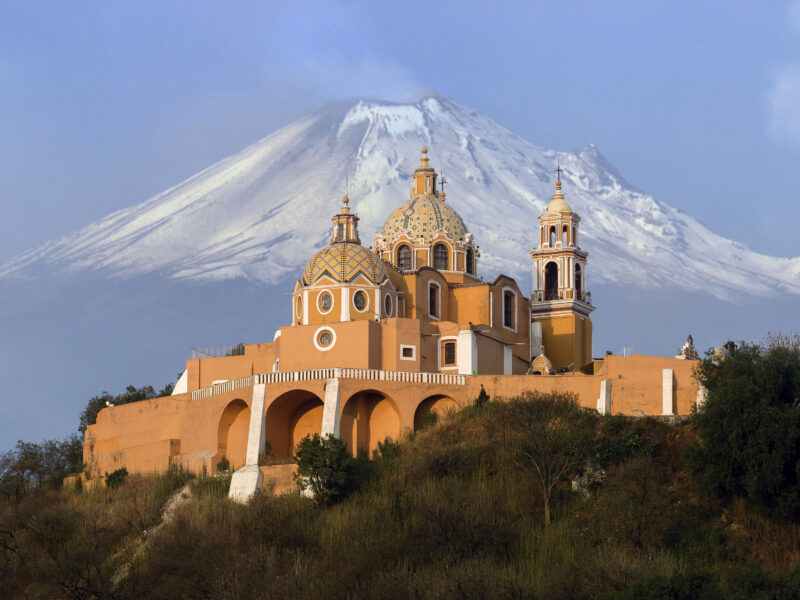
I ran into Max Loder, the German navigator I met in Chicoasen.
He was in awe of the event. "I feel like a pop star," he said. "The people have been amazing. Everyone seems to love it."
Loder got wistful as he gazed off at Popocatepetl.
"I feel like I'm in a meditative state," he said. "I only have to worry about my car running well and getting from one place to the other. It's very childlike, in a way."
I decided to travel straight from Puebla to Mexico City. I knew that if I didn't get to Mexico City in time, I would miss a highlight of the event: the racers' grand arrival in the city center.
Returning to the metropolis where I live - by far the biggest city in North America - the traffic was soul-crushing as usual. It was worse for the drivers behind me, who got delayed four hours when a gas truck exploded on the highway.
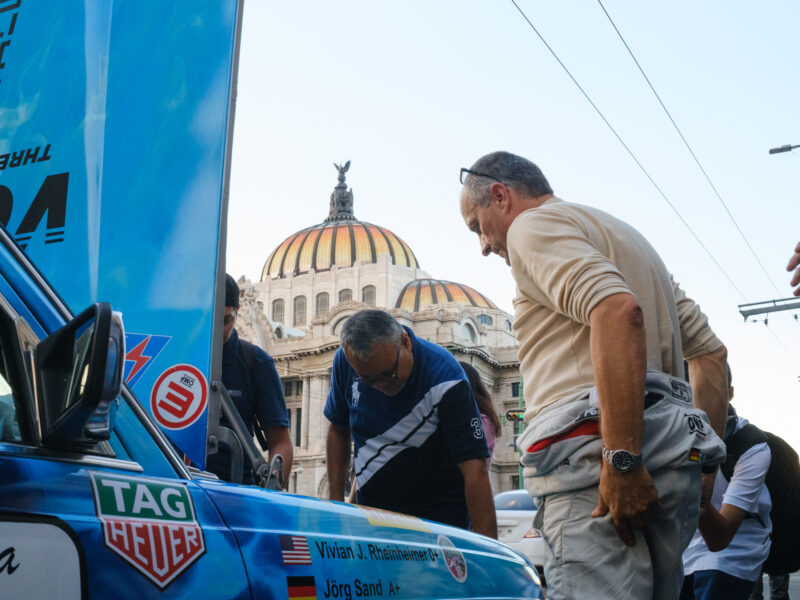
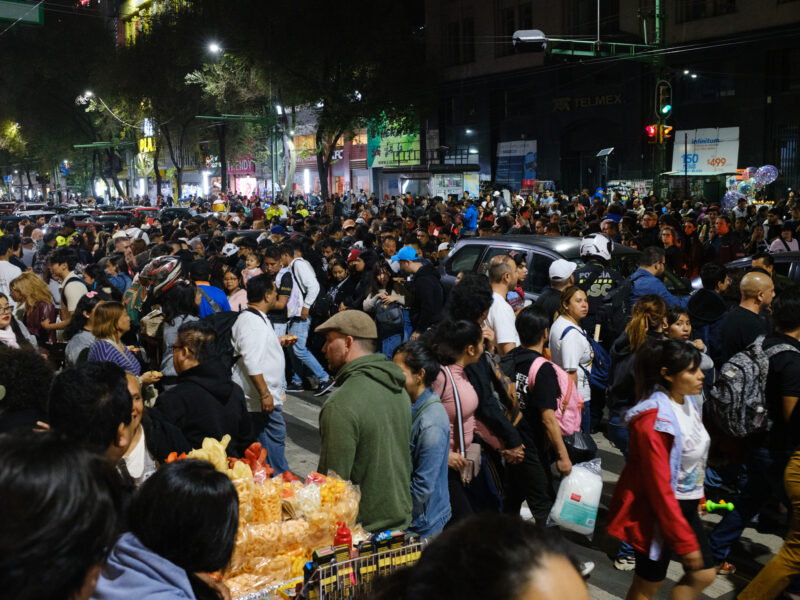
In downtown Mexico City, thousands of spectators swarmed the Palacio de Bellas Artes. As I waited with the crowd along Eje Central or Central Axis road, bits of information and gossip slowly trickled in about the much-anticipated racers.
Suddenly, a blue Mercedes pulled over in a bus lane in front of me.
It was Jrg Sand and his navigator Vivian Rheinheimer. To the delight of the crowd, they stopped and popped their hood right along one of the city's biggest thoroughfares.
"Problems with the fuel injection," Sand remarked casually.
His composure was shocking given the chaos of the scene. Electric trolley buses whizzed by, their passengers staring out the windows. Traffic cops whistled at commuters to keep moving. The crowd jokingly booed the regular cars. One cop tried to get the Mercedes to move until other cops got involved, yelling at the first cop to get lost.
In the crowd I met Rogelio Rubio. Growing up in Queretaro state, he had seen the original Carrera in 1950.
"Seeing the cars go by was an incredible spectacle," he said. "There were so many. Yes, there was television and we could see it on television, but it wasn't the same. It wasn't like smelling gasoline and being right up close to the cars."
As more race cars arrived, the excited mob pushed toward them. Crowd-control barricades slid into the street.
I spent the night at my apartment in Mexico City. I headed north the next morning, leaving behind the city's potholed roads.
A foggy dawn awaited me as I arrived in Queretaro state. Ascending past the cloudline, I carefully dodged huge patches of rubble on a steep, curving road.
I ran into an official, who waved me back in the other direction. The speed stage here was closed. Tropical Storm Raymond had caused serious rockslides, blocking several portions of the highway.
I backtracked to a nearby highway junction where I knew the racers would still be passing through.
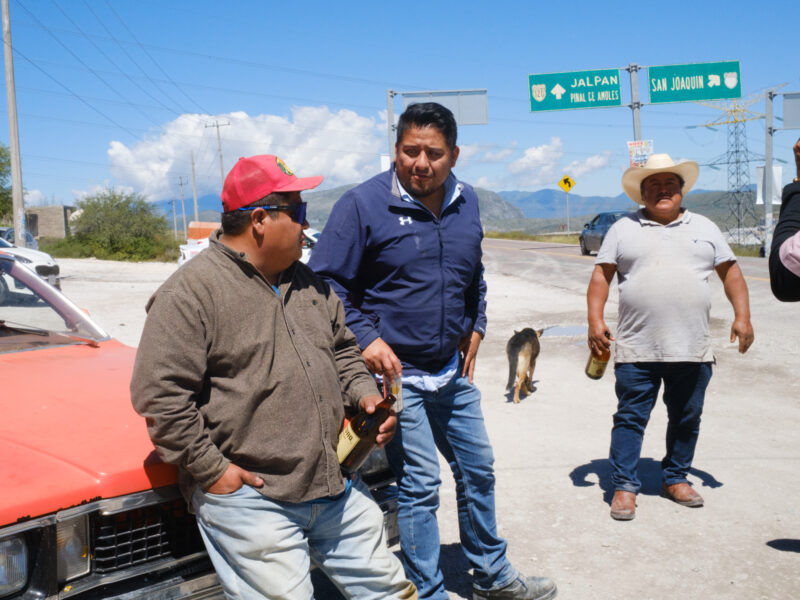
Outside a convenience store, I ran into Angeles Ramirez and her family. They lived nearby and had come out to see the race.
Her brothers were "Sundaying" - that is, drinking copious amounts of beer on their day off work from a nearby marble quarry. They rested their drinks on the hood of their replica "Dukes of Hazzard" Dodge Charger as they peppered me with questions. "How many cars are there?" her brother Omar asked. "How fast do they go?"
This convenience store - Fonda Tia Tere - is owned by Josefina Guadalupe Munoz de la Vega.
She had seen the Panamericana for years. Ten years ago, she recalled, five cars flew off a nearby cliff, one after another. "All was fine," she said with a laugh. "No one was hurt."
I said goodbye to my temporary hosts, then headed two hours to the city of Queretaro, the final stop of the day.
One of the most eventful parts of the race came the next day, on the "Mil Cumbres" or Thousand Hills scenic highway just outside Morelia in Michoacan state.
Picture hairpin turns, big elevation gains and potholes big enough to fit a family. Every driver I talked to said that Mil Cumbres was their favorite part, and the spectators seemed to like it, too. Crowds of people lined the narrow highway at every turnoff, bringing tents, grills and their own classic cars for the festivities.
I encountered a group of people cooking sausage and peppers for tortas on an open grill. They invited me over and insisted I eat with them.
We ascended a safe distance up the hillside. "You need to make sure to stay away from that gravel area, because the cars come through there," warned Jaime Vargas from Ciudad Hidalgo, Michoacan. He came to this same turnoff every year to watch the race with family and friends. As proof, he pulled out his phone and played a video at this very same spot from last year.
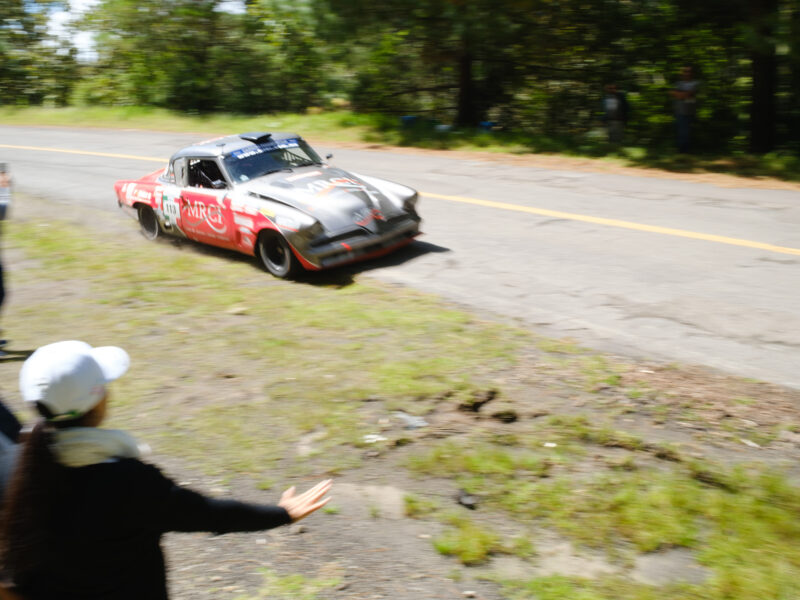
Vargas and his father, also named Jaime, are part of a Michoacan motorcycle group called "Los Viejos Vagos."
Sporting a long white beard, the elder Jaime Vargas recounted stories from his motorcycle trips across North America. He showed me photos of himself in Alaska, eating King Crab.
Suddenly, race cars came screaming down the road.
Vargas' warnings had been prescient: As the cars came barreled through, they turned right through the gravel area where we had been standing. I had avoided any injury, thanks to the family's knowledge of the race and respect for fast-moving vehicles.
Not everyone was so lucky. A few curves ahead of us, Emilio Velazquez and Javier Marin, then in third place, lost control of their red Studebaker "The Golden Tiger." They spun out of control, then slammed into some spectators.
No one died, but nine people ended up in the hospital. Organizers canceled the rest of the day, and Velazquez and Marin became the second 'did-not-finish' of the race. Later that day, organizers released a statement: Although the safety of spectators was their top priority, people needed to do their part and stay farther back from the roadway.
As we all drove north into Central Mexico, the days began blending together for me. I started having strange dreams about cars.
The Carrera Panamericana is like a marathon: not just about speed, but a test of endurance over long, hot days on the road.
The next day - the sixth day - felt like a hump day of the race. I was worn out, and it seemed like others were feeling that way, too.
The mood was subdued that afternoon when I visited a service stop in Silao, Guanajuato.
Loder arrived with his Falcon. I asked him how he was feeling about the crash. "It's terrible, of course," he said. "A lot of drivers were upset about the lack of organization."
And yet, "that's what kind of makes the Panamericana what it is, isn't it?" he added. "I don't think this event would be possible in many other places."
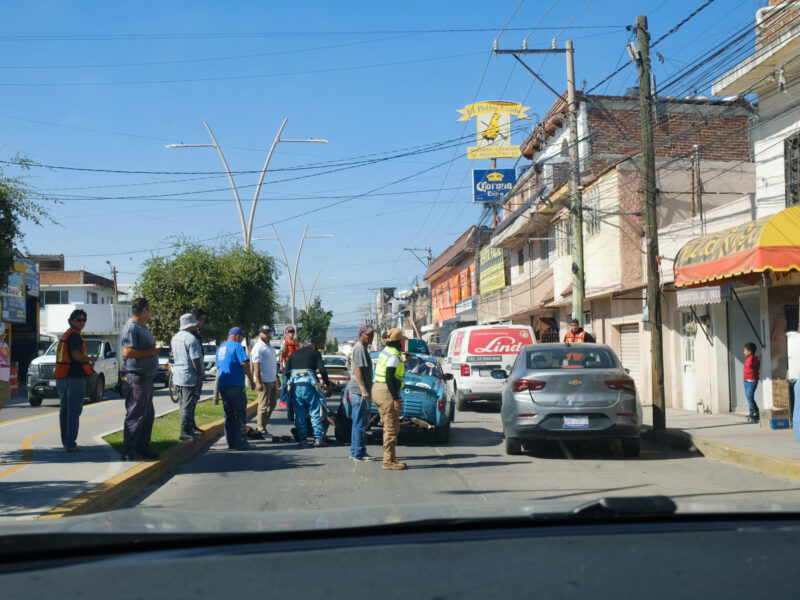
I looked across the parking lot, where torta vendors had set up shop alongside car insurance salesmen.
I thought about another service station in Michoacan from the day before. There was a prison behind it, but also fields of pink cosmos flowers. Schoolchildren were running around. That constant clash of joy and darkness is distinct to Mexico, and I wondered if it could help explain the existence of this race.
"Here, people have their own problems and aren't so concerned about some stupid guys driving cars too fast," Loder said.
After the usual drill (car tune-ups, swarming fans) it was time to head to the next speed stage.
Leaving Silao, I came across a commotion. A racing Volkswagen Karmann Ghia had blown a tire and was blocking the road. Police were doing their best to direct traffic and control gawkers.
Over the course of this race, I had driven through all types of landscapes, from the thick jungles and forests of rural Chiapas all the way to the more arid and developed north-central parts of the country.
The contrast today was particularly stark, as I moved from sprawling cities into sparse desert hills and finally to the old colonial city of Guanajuato. The city is shockingly beautiful, with steep cobblestone streets. When drivers congregated outside a 19th century theater that evening, I could tell who was seeing Guanajuato for the first time by the look of awe on their faces.
Spending the night in Guanajuato, I headed the next morning to a speed stage in the nearby Sierra de Lobos mountains.
There were no crashes or incidents this time. From where I was watching, it looked like the cars were floating through the hills under a perfect blue sky, with no road in sight. Then it was time to head to San Luis Potosi.

It was the second to last day of the race, and I was still trying to wrap my head around this whole event. The coordination between local governments and state police had been truly impressive. So was the will of drivers and teams to continue on this 2,000-mile journey despite road blocks, weather and massive crowds.
San Luis Potosi is a major manufacturing hub. As I got closer I passed symbols of economic progress, from shipping containers and trucks to logistics hubs and smokestacks. Interspersed with it all were native plants like prickly pears and Joshua trees.
Nearing the city center, I realized these were the smoothest roads I'd ever driven. At a stoplight, I saw Martinez's bocho hooked to the back of a tow truck.
It was now Day 8, Oct. 16 and the last day of the race: a drive through the Chihuahuan Desert from San Luis Potosi to the old silver mining city of Zacatecas.
The mood was high as cars lined up for their final run outside downtown San Luis Potosi that morning. I caught up with Cordero. Still in the lead, he was studying turns for the trip that day.
"Today is a considerable distance, so we shouldn't get complacent," he said. "We have to go all out. We have to attack. So, well, let's see how it goes and celebrate."
I asked other riders how they were feeling as I came across them.
Hilaire and Laura Damiron were now in second place. Laura said she felt confident they could make good time on the final day.
To demonstrate her commitment to crossing the finish line, Laura told me a story from a couple years ago.
"We ran out of water in the radiator [with] seven kilometers to go," she said. My husband parked the car and said, 'The race ends here.' And I said, 'Of course not.'"
She saw a house nearby. "I got out of the car, entered the house - broke into the person's house, really - [and] I started screaming, 'I need water!' An 80-year-old woman came. She told me to go through the house [and] start drawing water from the well." The woman asked her how many buckets of water she needed. "I said two."
"It's this spirit of helping without asking who you are," Damiron concluded.
I ran into Loder, too. He was still in good spirits, though even more exhausted.
"I feel excited. I feel nervous. I feel tired but happy overall," he said as other drivers started revving their engines." The car's in a good state. We are more or less in a good state. We should be able to get the car through the finish line."
The next time I saw any of them was 12 hours later, at the finish line in Zacatecas city.
Police had closed off the entire downtown. Hundreds of onlookers lined the hilly streets while regional bands played.
Cordero was the final winner.
Driving his car onto stage, he popped a bottle of champagne as red-smoke and gold-confetti bombs blasted. He was mobbed by a crowd of fans, but I managed to say a quick hi to him.
"Today we are very content. We have won seven Carrera Panamericana races," he said. "We are very happy but not satisfied, because next year we will go for another."
Carlos Cordero, director of the Carrera Panamericana, was walking up and down the street, taking in the sights.
He said he was proud of this year's race in particular. "The race returned to both Chiapas and Zacatecas," he said. "These are very traditional cities for the race, and where there's a strong historical connection." He motioned at the cheering crowd. "It fills us with pride for Mexico to be seen like this," he said. "This is Mexico."
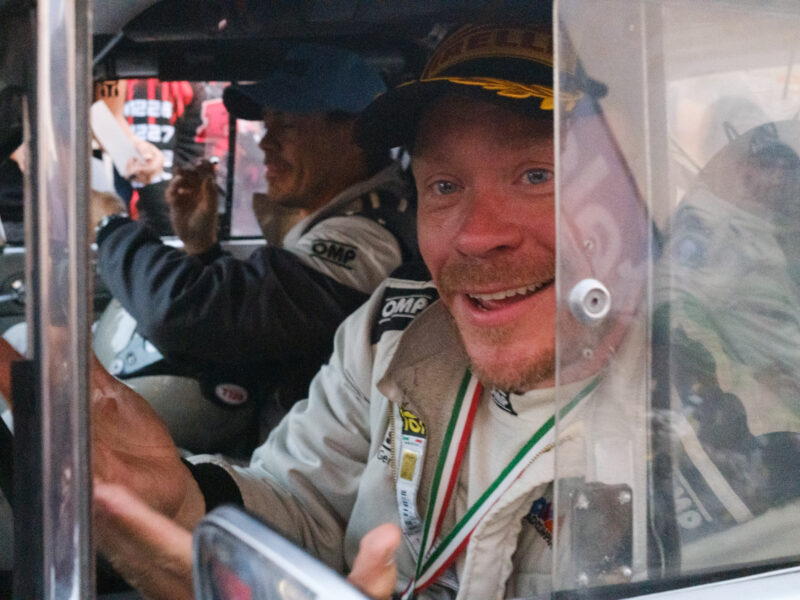
I wanted to know how others I'd met were feeling about the race being over.
I ran into the mechanics from Tequis Rally School. They were happy to be done, though Nava said he was in a bittersweet mood: For the first time, the car they were working on didn't finish.
"We don't really know what happened," he said. "It had to be towed to the end." He added that he wished the Carrera Panamericana could go back to its earlier days, when entry fees were lower and the race was more accessible to the general public.
Sand, the German driver, told me more about his adventures. After his car broke down on Eje Central in Mexico City, he'd flown in a mechanic from Germany with a needed spare part.
In the end, he was finally able to cross the finish line in Zacatecas.
"It feels great to finish," he said with a big smile. "I need noise-cancellation headphones next time."
I saw Loder once more, briefly, shaking hands with onlookers. He looked tired but joyful, a snapshot of a man living out a bucket-list dream.
It still felt like a dream to me, too. The next morning, I knew I would peel the press stickers off my rental car and leave Zacatecas.
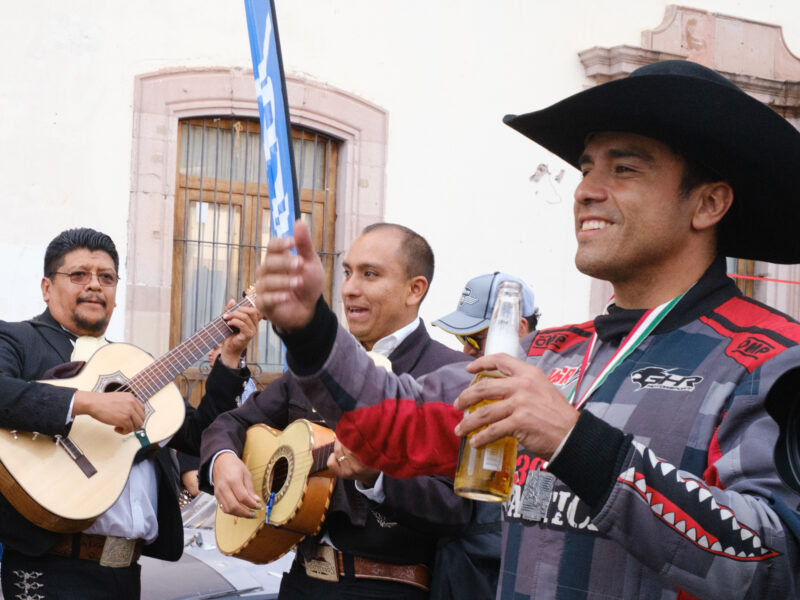
I ran into Cordero one more time towards the end of the evening, performing mariachi songs with a circle of fans.
Singing along with a hired band, he requested songs about his home state of San Luis Potosi, his navigator's home state of Morelos and every other state they'd driven through.
He showered the crowd with champagne, signed autographs for kids and posed for photos on the hood of his car. Then I overheard a mariachi give a warning to Cordero's team: They had only 30 minutes left before the party was really over.
Source: Courthouse News Service