

MEXICO CITY (CN) - A group of about 100 people continued their weekly protests in one of the FIFA World Cup's host cities by closing off a portion of a Mexico City highway over the weekend.
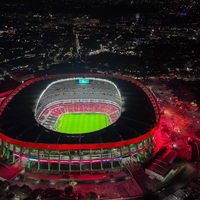
The Periferico Sur is the city's main peripheral highway in the vicinity of Estadio Banorte, which was reinaugurated on Saturday for a pre-World Cup matchup between Mexico and Portugal after being closed since May 2024 for World Cup renovations.
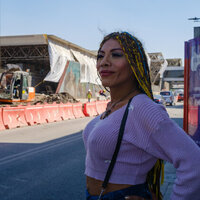
Demonstrators closed down a portion of the highway Saturday by staging a soccer game of their own and painting the area with slogans and art as a way to command attention to social issues they believe their government continues to ignore by prioritizing World Cup construction and projects instead. Mexico City will host the inaugural match on June 11.
Vloque Negro, a Mexico-City-based artist originally from Ciudad Nezahualcoyotl, has practiced what he calls "graphic art intervention" for more than 20 years, painting socially and politically minded murals and graffiti in public spaces around the city.
"So today we're closing a major avenue in Mexico City to express our discontent. The World Cup is accelerating social conflicts in the city related to the displacement of people. There have been many evictions throughout the entire city, and also a major water problem. The towns in this area have been protesting against all the construction projects and against everything that the World Cup brings and also everything it forgets- everything that it erases," said Vloque during an interview Saturday.
Community organizers in the Santa rsula Coapa neighborhood of Mexico City, where Estadio Banorte is located, have been organizing against the construction of World Cup-related mega projects since March 2024.
In 2018, Mexico's National Water Commission (CONAGUA) granted an annual water concession of 450,000 cubic meters to Televisa Group for its own exclusive use. In 2024, Televisa created a corporate spinoff company called Grupo Ollamani, which now owns Estadio Banorte.
The southern Mexico City neighborhoods surrounding the stadium have frequent water shortages, and many neighborhoods in Mexico City have their water delivered to them on trucks as it does not run from the tap.
In the year leading up to the first World Cup match in June, numerous families have been forcibly evicted from their homes to make way for building renovations to cater to short-term renters.
"In Mexico, there's a crisis of missing persons, and all this celebration that's going to happen here in Mexico and in the two other countries, well, it tries to erase many of these current problems. So, the big problem is that they're ignoring all these social problems to show off the country," said Vloque.
On March 12, President Claudia Sheinbaum publicly stated that violent crimes in Mexico have decreased, a tally that some experts say is inaccurate and only serves to mask the country's ongoing disappearance crisis.
Jalisco government data shows that there are 16,095 people disappeared in the state, Mexico's other World Cup host site.
In February, a Jalisco congressional regulation was passed to legally limit posting missing persons flyers in public.
Vloque sees disruptions like the one on Saturday, and his public art practice in general, as a way to create momentary public autonomy.
"It is an attempt to take people out of their daily routine. Society is very enslaved in a certain way. They have us working and suffering, packed into public transport, we see that the city is getting more and more unlivable. That's why we're here," he said.
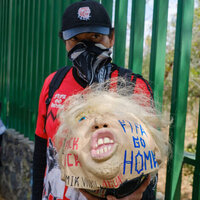
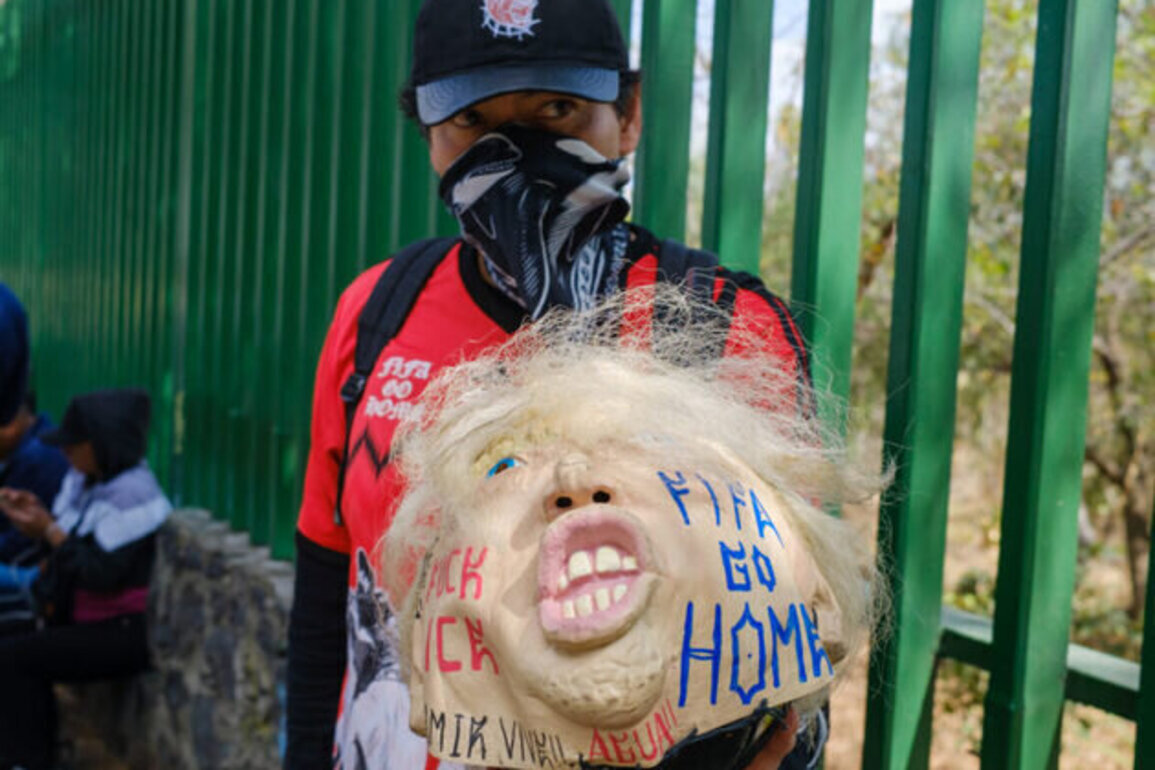
One artistic contribution Vloque made on Saturday was a soccer ball wrapped in a mask of U.S. President Donald Trump with anti-ICE and FIFA messages that was used in the soccer game among the demonstrators.
Another work near Estadio Banorte, which has since been painted over, featured a soccer ball fashioned into a skull laying on a cemetery with the slogan, "behind the World Cup, graveyards," a comment on Mexico's disappearance crisis.
Other large murals featured soccer players in their Mexican national uniform wearing the iconic masks used by the Zapatista Army of National Liberation during their uprising against the Mexican government in the 1990s, with the words "water for the people" painted between them.
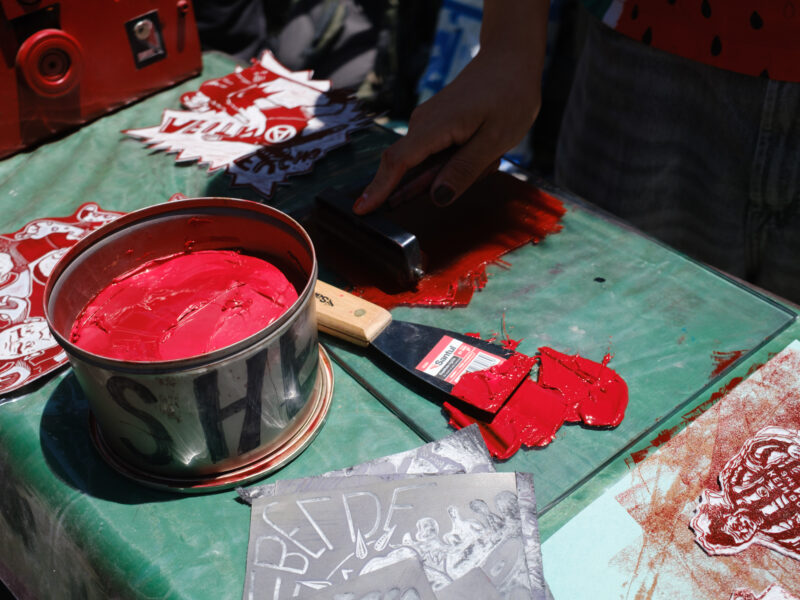
Along the corridor on Saturday, an art collective called "Error Grafico" printed anti-World Cup posters using a hand-cranked printmaking press.
"It's got two rollers we're using right now. We carve the vinyl with knives, which is the material used for some floors of houses, in the subway here in Mexico City, on the floors of cars. We carved it with small knives, and then we use the roller press with ink to create these designs that we can reproduce later on pieces of paper," said Leonardo Perez Solano, one of the members of the collective.
"We're putting up protest slogans. We're decorating some balls and repurposing the official World Cup logo with anti-fascist slogans on them, which are part of this protest, and we're giving them to people," he said.
Multiple demonstrators wanted to make it clear that they're not against soccer at all, such as Miye of the Revolutionary Youth Union of Mexico, who echoed Vloque's statements about reclaiming public space in the face of privatization brought on by the World Cup.

"We're being kicked out of our space, especially the space where we live and where we enjoy ourselves. Many street vendors were displaced. Houses were taken away to put up Airbnbs. There are many projects that are harming the community more than helping it," said Miye. "So, we decided to reclaim public space and use it for fun. It's very important to note that we're not against soccer, of course; we're in favor of sports and all the activities that unite us as a community. So, we decided to organize a huge soccer match that is open to the public - unlike the FIFA matches being held here in the country. Anyone can join, form their own team and come play."

Three demonstrators heavily involved in the soccer game on Saturday were dressed in full soccer equipment and uniforms, and two also donned Lucha Libre masks - a deep symbol of Mexican sporting culture.
"We are here today highlighting the struggle of all the people here in Mexico City whose work, whose studies are concentrated in the city center, and because of the World Cup, there have been repairs. There have been delays in transportation services. These services could very well have been for the good of the community and remain in the community. But what they're trying to do, through gentrification, is to shift people with limited resources out in order to make this whole area a little nicer, driven by FIFA, by the government and displacing everyone else," said Julian, minutes before jumping into a spirited soccer match while wearing a Read Madrid shirt as cars drove by.
Many drivers honked their car horns and screamed out their windows in approval of the demonstration as they drove by on the other side of the highway.
Source: Courthouse News Service