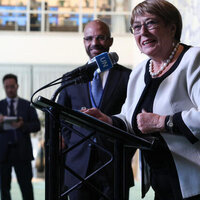


MEXICO CITY (CN) - United Nations High Commissioner for Human Rights, Volker Trk, gave a press conference Wednesday about his three-day visit to Mexico following the release of a report determining the Mexican government has been and continues to be sufficiently involved in the process of forced disappearances.
Mexican President Claudia Sheinbaum denied the validity of the report directly after it was released on April 2, saying that it only focused on past administrations and doesn't take into account work her administration has done with search collectives.
"Several issues were not considered by the committee. That's why the document was rejected," Sheinbaum said on April 6. The report had urged the U.N. Secretary-General to refer the situation to the U.N. General Assembly.
Trk commended the search collectives who look for their missing loved ones across the country.
"Families who search for years follow instructions without receiving answers and even risk their own lives to find their loved ones. This pain, with its differentiated impacts on children, migrants, and other populations, cannot be ignored. I express my empathy to all these people. And I told them that they are all human rights defenders and that they are absolutely right to demand attention and to obtain truth and justice, security, and protection," he said on Wednesday.
In talks with Sheinbaum, Attorney General of Mexico Ernestina Godoy Ramos, representatives of Amnesty International and Mexican search collectives during the trip, Trk said he called upon the Mexican government to strengthen its own institutions and search protocols.
"It is essential that the state continue to strengthen the search mechanisms, forensic identification processes, protection measures, and investigative capacities to address this crisis," he said. "The recent adoption of an updated national search protocol represents an important step. Its effective implementation, along with current processes of strengthening investigative capacities, communication between authorities, and adequate resources will be essential to achieve significant progress in the search for the disappeared and in the fight against this difficulty."
As recently as January 2026, Sheinbaum vowed to update the National Registry of Missing Persons by requiring a formal investigation file in order to classify a disappearance, a move some legal experts say is ineffective.
On Tuesday, hundreds of search collectives wrote an open letter to the High Commissioner, noting the U.N. report.
"This important step taken by the Committee represents a hope and an opportunity for the families of the more than 132,000 missing people in Mexico to locate their loved ones, to identify more than 70,000 remains of deceased people, bring those responsible to justice, and contribute to ending the disappearance crisis," the collectives say in the letter.
Trk called on the Mexican government to ensure that the families searching for their loved ones are recognized, their cause not politicized, nor manipulated and they are put at the center and protected.
"Their active participation and safety must be guaranteed. It is essential that any decision taken is effectively translated at the local level," he said. "And it has been established in social consensus that the issue of disappearances is a daily struggle against which we must fight. We need a national commitment that goes beyond political positions or a government mandate so that a true process of acknowledging the pain and the work of those seeking transparency and a serious commitment from the state can take place."
"Disappearances in any country around the world is an open wound and hits the basis of the social contract," Trk said.
The disappearance crisis has left more than 133,000 people disappeared and more than 72,000 people unidentified to date.
Source: Courthouse News Service